
If you’ve been moving through these days feeling heavier than usual not dramatic, not falling apart, just… heavy.
You are not imagining it.
This is the kind of tired that doesn’t disappear with sleep.
The kind that sits in your chest, your shoulders, your jaw.
The kind that shows up even on “good” days.
This isn’t “just stress.” This isn’t a personal failing. This isn’t you being too sensitive or not resilient enough.
What you’re feeling is real. It has a shape. Black women, brown bodies, woman of color especially if you are an eldest daughter carrying the emotional weight of your family this didn’t start yesterday.
This weight has been building.
We have to name it. Not to overanalyze it. Just to stop blaming ourselves for it.

When the Ground Won’t Stay Still
The world hasn’t felt stable in a long time.
And if you’re waiting for things to settle they might not. Not anytime soon. If anything, it feels like the ground keeps shifting faster than we can find our footing.
Policies targeting our communities. Immigration enforcement. Healthcare restrictions. Attacks on DEI programs. Increased surveillance. Economic instability hitting our families first and hardest. Rising hostility in public spaces.
For women of color, these aren’t abstract political conversations. They are not news stories you can look away from.
They’re about Our parents.
Our siblings.
Our friends.
Our children.
Our neighbors.
Our community
There’s something in the air that won’t settle, like your body is bracing even when nothing specific is happening. Like the forecast never fully clears.
Most people feel that and struggle.
Eldest daughters feel it and immediately start scanning for who else might need help.
And if you’re an eldest daughter, you’re not just managing your own anxiety.
You’re already the one everyone calls when they’re scared.
You’re the translator.
The researcher.
The contingency planner.
The steady voice while your own hands shake.
(Unpaid family operations manager. No salary. No PTO.)
That isn’t exaggeration. It’s the truth of what you’ve been carrying.

The Job You’ve Been Doing Without a Title
This is where the weight multiplies.
Eldest daughterhood whether by birth or by circumstance comes with a job description no one formally gives you:
Be the emotional container.
Anticipate the need before it’s spoken.
Hold the memory, the plan, the worry, so others don’t have to.
If you’ve been the one who checks in first. Notices the mood shift. Keeps track of what everyone needs. Adjusts yourself so the room stays steady.
That didn’t start last year.
That started a long time ago.
You learned early how to hold things together.
How to stay composed.
How to be useful when things were tense.
And when the world gets louder, that instinct doesn’t turn off. It sharpens.
You don’t just feel what’s happening you prepare for it. You brace. You anticipate. You hold.
That’s work. That is impacting your body.
Even when no one calls it that, even when no one notices the impact.
This is emotional labor reading everyone in the room while no one is reading you.
That’s a skill. It’s also exhausting.
Girl of course you’re tired.
The Layer That Doesn’t Get to Rest
Now add the layer that, for Black and Brown bodies, that doesn’t switch off.
The Work of Code-Switching
It’s the constant calculation of existing in spaces that weren’t built for you. The code-switching not just language, but posture, tone, facial expression. The quiet adjustments so other people feel comfortable.
That takes energy.
Hypervigilance for Survival
It’s the awareness in public spaces how you stand, how you speak, how you move. This isn’t paranoia. It’s pattern recognition your body learned long before you had words for it.
The Weight of Representation
It’s the pressure to show up “right.” To represent your community well. To educate. To bridge gaps. To be strong. To not be “too much.” All while carrying your own grief, anger, and exhaustion about what your communities face.
Researchers call this racialized stress and minority stress the real, documented cost of moving through systems that weren’t built with you in mind.
It’s the exhaustion of having to think about things your white peers never have to consider.
And you don’t get to clock out from it.
When It Comes Home With You
For BIPOC eldest daughters, this vigilance doesn’t stay outside.
You bring it home.
And at home, you often become the translator of the outside world to your family the buffer against its blows.
You carry the double awareness: the world’s instability and your family’s vulnerability.
You don’t get to say, “I’ll deal with this later.” Your body deals with it whether you’re ready or not. And then you’re still the one people lean on.
Girl, of course you are so damn tired.
The Impact of Community Care
For many Black and Brown eldest daughters in Minnesota and in cities like Chicago, Los Angeles, and Portland that vigilance extends beyond family into community.
This is community care under pressure.
Updating safety plans. Researching legal resources. Translating policy changes into real-life terms. Fielding scared calls. Being the steady voice while your own hands shake.
And this sadly ain’t new!
For example in Minnesota, many of these networks were built years ago out of necessity, grief, and resistance. After the killing of Philando Castile.
After George Floyd. Again and again, Black and Brown communities have created systems of care when formal systems failed or caused harm.
Mutual aid. Rapid response. Food distribution. Court support. Childcare coverage. Information sharing.
Right now in across the country, that looks like volunteers packing thousands of grocery boxes for families too afraid to leave home. Like neighbors waiting outside federal buildings to drive released detainees home because they were taken without phones or ID.
This work has always been carried by Black and Brown bodies often quietly. Often without sustained support. Often by the same people already holding their families together.
And now that same community is being asked to show up again.
For many eldest daughters, this isn’t new labor.
It’s familiar labor just heavier.
If this section stirred something in you, that doesn’t mean you need to do more.
It means your body recognizes the weight.
Take a breath.
You don’t owe anyone extra effort just because you care.
Putting Something Down
And yet here you are, still showing up.
This post is not meant to give you more steps to add to your list.
This is validation.
Pause for a moment. Put your hand on your chest. Feel the weight there.
Take a moment, say to yourself:
It makes sense that I feel heavy.
Then ask yourself one question:
What is one tiny thing I can put down today?
Not forever. Just today. It goes in a parking lot, ready when you go get it.
Maybe it’s not carrying your sibling’s anxiety. Maybe it’s muting a group chat for 24 hours. Maybe it’s letting a problem belong to someone else for one night.
And then give yourself permission to rest.
Because you’re human. And humans are not built to carry everything at once or to do it perfectly.
You already know exhaustion this deep usually has a shape. A pattern. A role you’ve been playing so long it stopped feeling like a role.
And once you see the shape, you get to decide what still belongs to you.
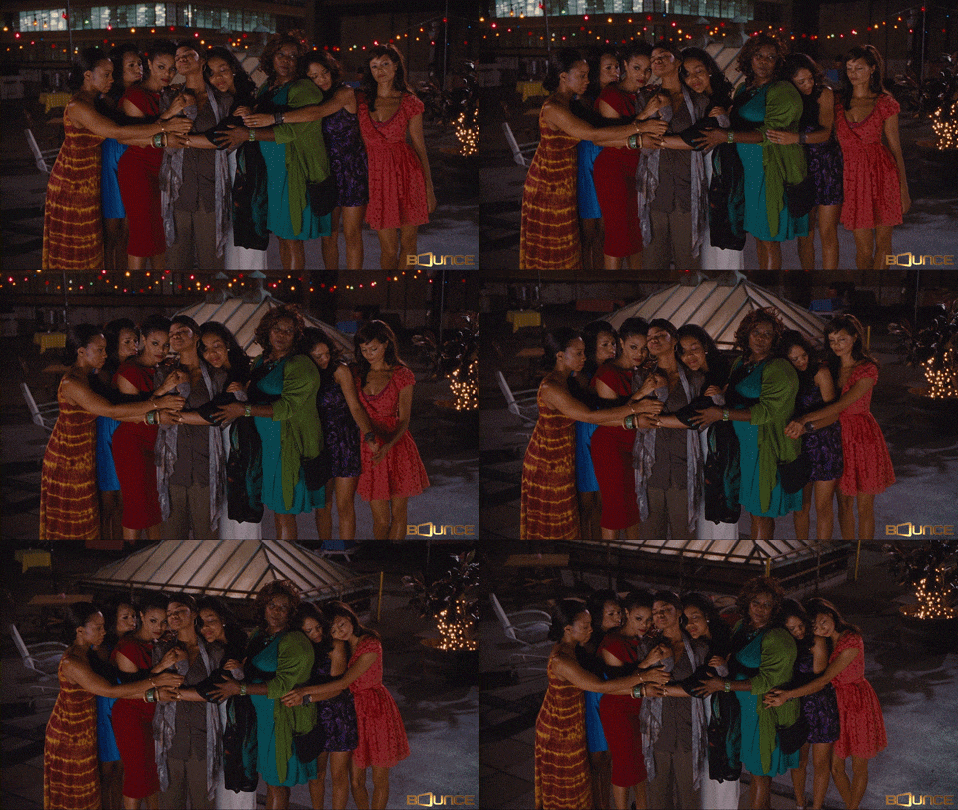
This gathering exists because carrying this weight in silence is how we break.
You are not imagining the weight.
And you don’t have to hold it by yourself.
Welcome back to the gathering. 💜
Until the next gathering,
rest when you can. Take up space. Exhale fully.
Gathering Eldest Daughters
https://shorturl.fm/86VJe